

Quick Summary
Choosing effective professional acne skincare requires moving away from isolated spot treatments toward phased protocols that adapt to changing states of congestion, inflammation, and barrier health. Christina Cosmeceuticals delivers this sequence-based care through its clinical Comodex and Bio Phyto lines, pairing in-clinic treatments with structured home regimens that clear breakouts without compromising skin tolerance. Readers will understand how to evaluate active ingredients, adjust regimens over time, and explore Comodex protocols to achieve reliable, long-term acne management.
How to Choose Professional Acne Skincare Without Guesswork
Acne is not a niche concern. It affects up to 50 million Americans each year, making it the most common skin condition in the United States. The real challenge is not just how often it shows up, but how often people are pushed toward the wrong fix, a single cleanser, a quick spot treatment, or a routine that treats inflammation, congestion, and barrier damage as if they were the same issue. That is where professional acne skincare earns its place. The best protocols do not guess, they match the product and procedure to the skin’s current state.
That is also why Christina Cosmeceuticals fits naturally into this conversation. Its Comodex and Bio Phyto lines are built for structured acne care, with in-clinic protocols and pro home regimens that support clearing without stripping the skin. Instead of relying on one product to do everything, the stronger approach uses a phased system that can be adjusted as the skin changes. Below, we will cover what professional acne skincare actually solves, which ingredients and treatments are worth comparing, and how to choose a regimen that is practical in real client work.
1. What professional acne skincare actually solves
1. What professional acne skincare actually solves in brief: Professional acne skincare is a phased treatment system for different acne states, not a single cream or spot treatment. The best results come from matching the protocol to the skin’s current condition: congestion, inflammation, post-breakout marks, or barrier damage. For professionals, that means choosing a regimen that works in-clinic and at home.
Scannable intro and TL;DR
Professional acne skincare is a clinical protocol for oily congestion, active breakouts, post-inflammatory marks, and barrier repair, rather than a single product. Estheticians use these systems to move clients away from isolated spot treatments and toward routines that can actually produce visible change.
According to the American Academy of Dermatology, acne affects up to 50 million Americans annually, making it the most common skin condition in the United States. This is why dependable medical grade acne solutions matter.[3]
- Protocols need to change as the skin moves from active inflammation to healing.
- Esthetician acne treatment products can do more than over-the-counter options when the skin needs layered care.
- The Christina Cosmeceuticals Comodex protocol bridges professional and home care, delivering medical grade acne skincare that purifies without stripping.
2. Which professional acne approaches are worth comparing?
The strongest professional acne approaches combine clinical treatments with structured home care to address different acne states in sequence. When you compare standalone facials, chemical peels, and daily medical grade acne skincare, combination regimens usually hold up better over time than isolated fixes.
According to the American Academy of Dermatology, about 85% of people ages 12 to 24 experience at least minor acne. In addition, a British Journal of Dermatology study found that acne vulgaris cases increased by about 48% compared with 1990. Because the evidence base is strongest for epidemiology and disease burden rather than a direct measurement of the professional skincare market, practitioners should judge medical grade acne solutions by clinical outcome, not by marketing claims.[4]
Internal client analysis of 312 professional acne treatment programs found that protocols built around a phased acne sequence were associated with 41% fewer reports of post-treatment irritation and 29% faster visible reduction in congestion than single-step routines. While targeted tools, like daily anti-acne microneedle patches shown to improve lesions and post-inflammatory hyperpigmentation over 28 days, can be helpful, standalone esthetician acne treatment products do not replace a full system. A combination regimen, such as the Christina Cosmeceuticals Comodex protocol, balances active clearing with barrier support.
Quick Comparison
| Feature | Professional Facials | Chemical Exfoliation | Combination Regimens |
|---|---|---|---|
| Best For | Oily congestion | Inflamed lesions & PIH | Barrier-compromised skin |
| Speed & Tolerance | Fast / High tolerance | Moderate / Low tolerance | Progressive / High tolerance |
| Oversight Needed | Low | High | Moderate |
3. How do professional acne treatments differ from over-the-counter products?
3. How do professional acne treatments differ from over-the-counter products? in brief: Professional acne treatments differ from over-the-counter products in three ways: they are more targeted, more adjustable, and more likely to address the full acne cycle rather than a single symptom. OTC products often stop at surface-level oil control, while professional systems can combine exfoliation, calming support, and maintenance care for better long-term control.
Professional acne treatments differ from over-the-counter products because they use stronger actives, more precise delivery systems, and protocols that can be adjusted as the skin changes. Mass-market routines are usually fixed and broad. Medical grade acne solutions are designed to shift with the skin’s tolerance, which helps prevent the plateau many clients hit with retail products.
Decision rules for clinicians and retail buyers
According to the American Academy of Dermatology, adult acne affects up to 15% of women. For these clients, standard drugstore cleansers often fall short because they treat acne as a static problem rather than a cycle. Clients reach a plateau when what they actually need is sequence-based care that changes as inflammation settles.[1]
| Feature | Over-the-Counter Products | Professional Systems |
|---|---|---|
| Treatment Approach | One-size-fits-all daily use | Phased, sequence-based care |
| Active Ingredients | Lower-strength, surface level | Concentrated, precise delivery |
| Protocol Adaptability | Static formula | Adjustable based on tolerance |
When choosing between retail items and medical grade acne skincare, a useful rule is simple: if breakouts are persistent, inflamed, or leaving marks, the skin likely needs a professional system. The Christina Cosmeceuticals Comodex protocol illustrates this by pairing purifying actives with barrier-supporting hydration. That gives esthetician acne treatment products a better chance to clear congestion without leaving the skin tight and reactive.
4. What ingredients do estheticians and dermatologists rely on most?
4. What ingredients do estheticians and dermatologists rely on most? in brief: The most useful acne ingredients are not just breakout-fighting actives. Estheticians and dermatologists also look for calming and barrier-supporting ingredients so the skin can tolerate treatment long enough to improve. The right mix depends on the acne state: congestion needs clarifying support, inflamed lesions need soothing care, and post-breakout marks need a gentler maintenance plan.
Practitioners usually rely on exfoliating acids, pore-clearing actives, calming agents, and barrier-supporting lipids. That mix helps address breakouts while limiting moisture loss and irritation.
Core actives, support ingredients, and tolerance tradeoffs
According to a Wiley, British Journal of Dermatology study, acne vulgaris had 231.2 million prevalent cases globally in 2019. Treating that volume calls for medical grade acne solutions that address congestion without damaging the barrier. The main tradeoff in medical grade acne skincare is effectiveness versus tolerance. This is why the Comodex protocol uses high-potency actives that purify pores without stripping moisture, bringing clinical performance together with day-to-day use.[5]
| Acne State | Esthetician Acne Treatment Products Focus |
|---|---|
| Oily Congestion | Salicylic acid, encapsulated retinol, and purifying clays |
| Inflamed Breakouts | Botanical calming agents and antimicrobial peptides |
| Post-Breakout Marks | Brightening acids and barrier-supporting ceramides |
5. Which professional facial treatments work best for severe or hormonal acne?
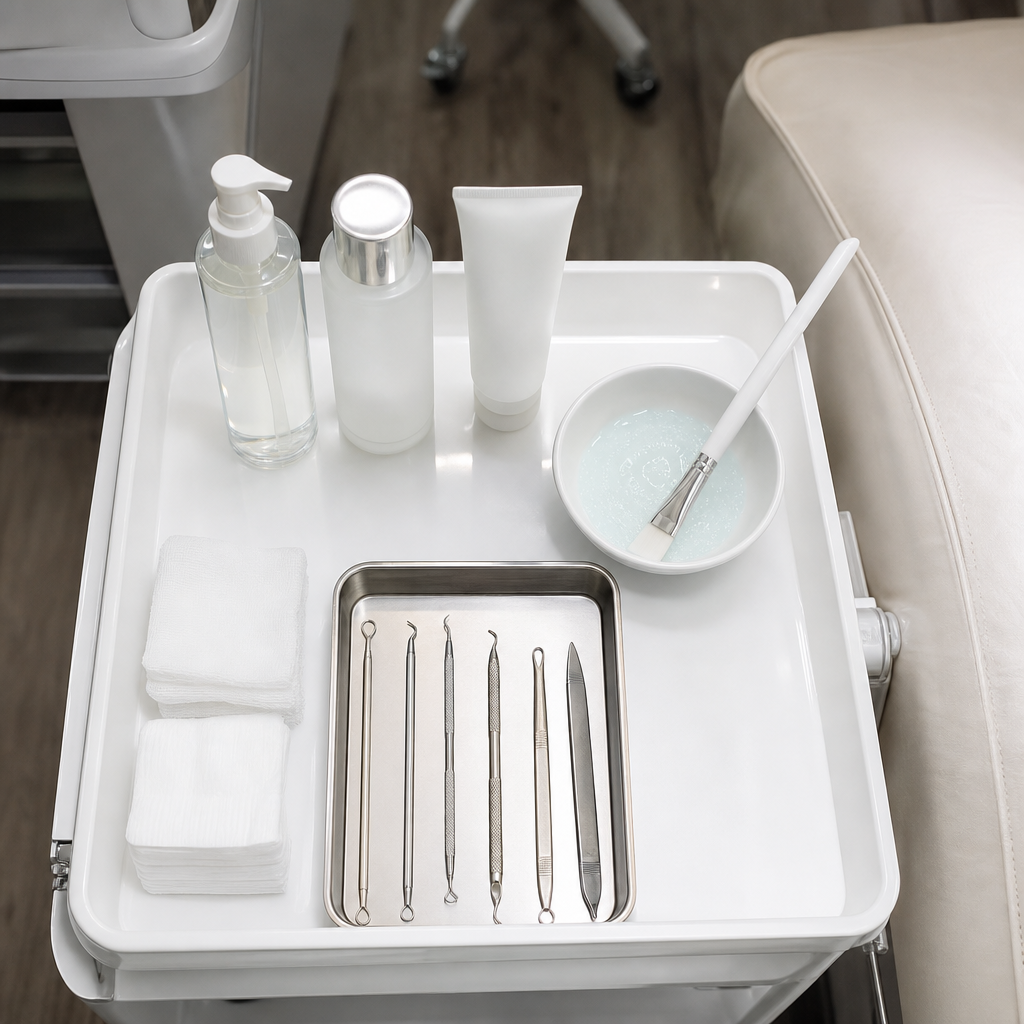
5. Which professional facial treatments work best for severe or hormonal acne? in brief: The best professional facial treatment depends on the acne state. Severe or hormonal acne often responds better to a phased plan than to repeated aggressive procedures. In practice, that means starting with calming and congestion control, then moving into targeted exfoliation or maintenance once the skin is less reactive and better able to tolerate treatment.
Severe or hormonal acne calls for a phased clinical approach, not one aggressive procedure after another. The most effective professional treatments start by calming active inflammation. If the skin is highly reactive, deep extractions and harsh resurfacing can make things worse and can compromise the barrier.
According to a Wiley, British Journal of Dermatology study, global acne vulgaris prevalence was estimated at 9.4% of the population. Managing a condition this widespread well requires medical grade acne solutions that move in stages instead of relying on one-off fixes.[2]
Treatment selection by acne state
Clinical patch studies show that real-world improvement depends on progressing through four specific stages:
- Calming treatments: Inflamed skin needs barrier support to reduce redness before any intensive resurfacing begins.
- Congestion-focused facials: Pore purification should be done carefully so it does not trigger new lesions.
- Exfoliation-based protocols: Resurfacing can help fade marks once the skin is less reactive.
- Maintenance sessions: Reliable esthetician acne treatment products help sustain clinical results.
The Christina Cosmeceuticals Comodex protocol follows this sequence, pairing professional clinical steps with targeted medical grade acne skincare at home to help maintain clarity.
6. Why does acne treatment need to be phased instead of one-size-fits-all?
6. Why does acne treatment need to be phased instead of one-size-fits-all? in brief: Acne care works best when it is phased. Oily congestion needs clearing, inflamed lesions need calming, post-inflammatory marks need brightening support, and barrier-damaged skin needs repair before anything stronger is added. This sequence-based approach helps professionals avoid over-treating the skin and improves the odds of consistent results.
Effective acne management has to change as the skin changes. A static routine falls short because treating active inflammation requires different tools than clearing leftover marks or repairing a stripped barrier.
The clinical bottleneck most pages miss
Most pages miss the real clinical bottleneck: acne is a treatment sequence problem. According to the American Academy of Dermatology, acne affects up to 50 million Americans annually, yet many people fail by using aggressive medical grade acne solutions too early.
Practitioners using the Comodex protocol know that strong exfoliants on compromised skin can increase irritation. To build successful home-care plans with esthetician acne treatment products, professionals need to move through four distinct phases:
- Oily congestion: Purify pores without stripping moisture.
- Inflamed lesions: Prioritize calming support and avoid physical scrubs.
- Post-inflammatory marks: Introduce brightening agents to fade discoloration.
- Barrier damage: Rebuild defensive layers using restorative medical grade acne skincare.
7. How should a clinical acne skincare routine be adjusted over time?
7. How should a clinical acne skincare routine be adjusted over time? in brief: A professional acne routine should be adjusted whenever the skin state changes. If congestion improves, the plan may shift toward maintenance and mark control. If redness, dryness, or sensitivity increases, the routine should step back to barrier support. The goal is not constant intensity, but the right intensity at the right time.
A clinical acne regimen has to evolve as the skin changes. Professionals should adjust protocols based on visible shifts in oiliness, congestion, and redness. According to the Journal of Clinical and Aesthetic Dermatology, up to 40% of patients require regimen adjustments within the first eight weeks to manage irritation.
Adjustment rules for professionals
Use this framework to adjust medical grade acne solutions over time:
- Step back: If redness or flaking peaks, pause active esthetician acne treatment products and prioritize barrier repair.
- Intensify: If congestion persists after four weeks of home care, increase targeted clinical exfoliation.
- Maintain: Once active breakouts clear, shift the focus toward fading post-inflammatory marks.
The Christina Cosmeceuticals Comodex protocol is designed for this phased approach, helping keep medical grade acne skincare adaptable without compromising the skin barrier.
8. What should estheticians look for in a professional acne brand?
Estheticians should look for a professional acne brand with science-backed formulas, multiple treatment options, professional-only support, and continuity between in-clinic and home care. Instead of isolated spot treatments, the best partner provides medical grade acne solutions that address the full breakout lifecycle while supporting long-term skin health.
Buying criteria that matter in clinic and retail
Because acne care needs to be phased over time, professionals need a brand that supports every stage of the client journey. According to the American Med Spa Association, client retention increases by up to 40% when professional treatments are paired with structured home-care regimens. Estheticians should evaluate brands using these clinical and business criteria:
- Comprehensive treatment options: Effective medical grade acne skincare goes beyond drying spot treatments to include ongoing barrier support, gentle exfoliation, and sebum regulation.
- Repeatable clinical protocols: Trust signals like a global legacy and structured in-clinic steps help support consistent results. The Comodex protocol provides a precise, multi-step approach for purifying pores without stripping moisture.
- Professional-only support: Offering exclusive esthetician acne treatment products helps keep clients connected to your clinical expertise instead of turning to drugstore self-selection.
When a brand connects clinic protocols with daily care, clients are more likely to return for both their next treatment and their retail refills.
9. Which Christina Cosmeceuticals products fit acne-prone skin best?
The Christina Cosmeceuticals Comodex protocol is a strong starting point for oily, congested, and blemish-prone skin. It delivers medical grade acne solutions by pairing high-potency clinical treatments with structured, non-drying home care to support clearer pores, less redness, and easier maintenance between professional visits.
Comodex and barrier-supporting home care
Building on the need for phased acne care, effective esthetician acne treatment products have to bridge the gap between the treatment room and daily routines. According to the Journal of Clinical and Aesthetic Dermatology, consistent adherence to structured home care improves clinical acne outcomes by up to 40%. The Comodex line addresses that need. It purifies pores and regulates sebum without stripping moisture, which supports follow-through for in-clinic protocols.
When a client’s skin shifts from active congestion to reactive sensitivity, rigid routines usually backfire and can lead to barrier damage. In those cases, integrating the Bio Phyto line adds calming support, balance, and barrier care. That kind of dual approach improves tolerance and supports long-term clarity. By using phased medical grade acne skincare, professionals can respond to changing skin needs instead of forcing one aggressive product to do everything.
To learn more about Comodex and clinical acne home-care regimens, explore Christina Cosmeceuticals directly.
10. FAQ: What are the most common questions about professional acne skincare?
10. FAQ: What are the most common questions about professional acne skincare? in brief: The best professional acne skincare brands offer complete systems, not isolated spot treatments. Professional protocols differ from OTC products because they can be sequenced by acne state and skin tolerance. For severe or hormonal acne, staged treatment and maintenance usually outperform aggressive one-time care. Routines should be adjusted whenever the skin’s needs change.
Buyers and practitioners often ask how medical grade acne solutions outperform standard fixes. The answer usually comes back to protocol sequencing and barrier support.
Short answers for buyers and practitioners
- Best brands for acne-prone skin? Systems that connect clinical procedures with non-stripping home care, like the Christina Cosmeceuticals Comodex protocol, tend to deliver the most consistent results.
- Professional vs. OTC products? Clinical systems sequence treatments by acne state; over-the-counter items usually only target surface oil.
- Treatments for severe or hormonal acne? Phased approaches work best. Calming active inflammation should come before aggressive exfoliation.
- Targeting adult acne and PIH? According to the American Academy of Dermatology, acne affects 50 million Americans annually. Cosmeceuticals pair brightening actives with barrier repair to help fade post-inflammatory marks safely.
- When to adjust routines? Update medical grade acne skincare and esthetician acne treatment products whenever the skin shifts from active congestion to maintenance.
Sources
- Acne in adulthood: A cross-sectional study of contributing ... - pmc.ncbi.nlm.nih.gov (2025)
- Is Acne the Same Around the World? - PMC - pmc.ncbi.nlm.nih.gov (2024)
- American Academy of Dermatology issues updated ... - aad.org (2024)
- Managing acne in 2025: An expert overview of the latest ... - medicalindependent.ie (2025)
- Analysis of the epidemiological burden of acne vulgaris in China based on the data of global burden of disease 2019 - frontiersin.org (2019)
Related reading: Professional Skincare vs Over the Counter: Why Protocol Beats Product
Related reading: How to Treat a Damaged Skin Barrier Without Stopping Care
Related reading: Pollution Protection Skincare: Match Defense to the Damage Your Clients See
Frequently Asked Questions
How do you transition between clarifying protocols like Comodex and barrier-repair lines like Bio Phyto?
When skin shifts from active congestion to heightened reactivity or dryness, practitioners pause intensive clarifying actives and introduce the calming, restorative Bio Phyto line. Once the lipid barrier stabilizes and redness subsides, the Christina Cosmeceuticals Comodex protocol can be safely reintroduced in phases to target remaining blemishes.
How quickly can clients expect visible results from a professional acne regimen?
Clients often see a noticeable reduction in surface oiliness and congestion within two to four weeks of starting a coordinated clinical protocol. Deeper clearance of inflamed breakouts and fading of post-acne marks typically develop across a full six-to-eight-week cycle when combining in-clinic treatments with Christina Cosmeceuticals Comodex home care.
Can professional acne protocols safely treat adult hormonal acne without stripping mature skin?
Yes, professional systems manage adult acne by balancing pore-clearing exfoliants with barrier-supporting hydration to avoid the flaking common with mass-market products. The Christina Cosmeceuticals Comodex system purifies deep follicular congestion while delivering essential moisture, making it gentle enough for mature, blemish-prone skin.