

Quick Summary
This article examines why standard over-the-counter products often fail against stubborn concerns like hyperpigmentation, acne, and aging, demonstrating how professional cosmeceutical ingredients deliver targeted, clinically meaningful results. Christina Cosmeceuticals illustrates how advanced delivery systems and high-potency active ingredients successfully bridge in-clinic treatments with tailored home-care routines for optimal skin tolerance. Readers will learn how core active categories function across different skin states, empowering them to consult licensed skincare professionals or select targeted cosmeceutical regimens tailored to their specific needs.
Cosmeceutical Ingredients That Solve What OTC Products Cannot
If you have already tried the usual over-the-counter options and still see stubborn hyperpigmentation, breakouts, or early signs of aging, the problem may not be your routine, it may be the ingredient strategy. The real value of cosmeceutical ingredients is not just higher strength, but better targeting, clinically relevant concentrations, and formula design that supports skin more effectively than standard cosmetic products usually do.
That distinction matters. Market research continues to show steady growth across cosmetic ingredients and skincare ingredients, with projected CAGRs generally ranging from about 4.3% to 8.2%, depending on the segment and how the market is defined. But not every ingredient is built for the same job. Christina Cosmeceuticals sits in that professional space with high-potency actives, dual-system methodology, and carefully built complexes that connect in-clinic treatment goals with home-care maintenance.[1]
In the sections ahead, we will break down how professional cosmeceutical ingredients differ from standard cosmetic actives, which ones fit common skin concerns, and why delivery and compatibility often decide whether a product actually performs. For personalized guidance, a licensed skincare professional is still the right starting point.[4]
Introduction: Why Ingredient Intelligence Separates Clinical Results from Cosmetic Claims
Ingredient intelligence separates clinical results from cosmetic claims because it puts skin state, concentration, and delivery first. Standard over-the-counter products often rely on trend-led formulas, while professional skincare ingredients are selected for specific outcomes, such as calmer acne, less visible pigmentation, or better support for aging skin.[5]
Recent market estimates continue to point to strong demand for cosmetic ingredients and skincare ingredients. Even so, active ingredients in cosmeceuticals remain a more specialized category. Licensed professionals and high-intent consumers are moving away from one-size-fits-all routines and toward formulas chosen for the problem in front of them, whether that is post-inflammatory hyperpigmentation, barrier damage, or visible laxity.[2]
Christina Cosmeceuticals reflects that approach through its dual-system methodology, which connects in-clinic treatments with professional home care. The practical question is not just which active is included, but when to use it, what to pair it with, and when to pause it.
How Do Cosmeceutical Ingredients Differ from Standard Cosmetic Ingredients?
How Do Cosmeceutical Ingredients Differ from Standard Cosmetic Ingredients? in brief: Cosmeceutical ingredients are bioactive compounds, such as retinoids, peptides, and clinically used antioxidants, formulated at concentrations high enough to influence skin function beyond basic conditioning. Standard cosmetic ingredients usually focus on cleansing, moisturizing, or improving feel, while cosmeceuticals often rely on more advanced delivery systems and multi-active formulas. In the U.S., the FDA generally regulates them as cosmetics unless a product makes drug claims.
That regulatory line matters. Under the Federal Food, Drug, and Cosmetic Act, the FDA treats these products as cosmetics unless they are marketed to treat disease or change skin structure in a drug-like way. Interest in active ingredients in cosmeceuticals keeps growing, alongside broader skincare ingredients markets that continue to expand year after year.[3]
Concentration thresholds that define clinical efficacy
Standard cosmetics often stay focused on surface conditioning. Professional skincare ingredients are typically built with higher active levels so they can influence skin behavior more directly. With retinoids, for example, the percentage and form both matter. Retinoic acid works directly, while retinol and retinaldehyde need conversion in the skin, which can make them easier to introduce in more sensitive routines.
Delivery systems that determine whether an active actually reaches the target layer
A higher concentration does not help if the ingredient sits on the surface and irritates without doing useful work. That is why delivery systems matter. Christina Cosmeceuticals uses synergistic systems that combine botanical actives with biomimetic complexes so active cosmeceutical ingredients have a better chance of reaching the skin environment they are meant to support.
| Feature | Standard Cosmetics | Professional Formulations |
|---|---|---|
| Function | Surface hydration and conditioning | Support for skin function and visible concern management |
| Delivery | Surface-level | Encapsulated or time-released delivery |
| Strategy | Single-ingredient focus | Multi-action complexes |
The Five Core Categories of Active Ingredients in Professional Cosmeceuticals
The Five Core Categories of Active Ingredients in Professional Cosmeceuticals in brief: Professional cosmeceuticals usually draw from five main ingredient groups: retinoids for renewal, peptides for structural support, antioxidants for oxidative stress, hydroxy acids for exfoliation, and botanical or marine-derived actives for targeted support. The most useful formula is not the one with the longest ingredient list, but the one built for the right skin state.
Professional skincare ingredients depend on active compounds that can be matched to a specific concern. That is where formulation quality matters most. Some ingredients are better for congestion, some for dullness, and others for skin that is already irritated or fragile.
Retinoids and Vitamin A Derivatives
For cell turnover and visible photodamage, retinoids remain one of the most studied options. The clinical strength retinol benefits come from their role in supporting renewal and the look of firmer skin over time. Retinoic acid acts directly, while retinol and retinaldehyde require conversion, which is why they are often easier to introduce gradually.
Peptides and Growth Factors
Peptides work as signaling molecules. Some support collagen-related pathways, others help deliver minerals, and some are used in formulas aimed at softening the look of expression lines. These active cosmeceutical ingredients are useful because they can support the skin without the same level of barrier stress that stronger exfoliating agents may cause.
Antioxidants and Radical Scavengers
Antioxidants help reduce the impact of oxidative stress. Vitamin C, vitamin E, niacinamide, and resveratrol are common examples, and they are often combined because each one plays a slightly different role. In practice, this matters for both protection and formula stability.
Hydroxy Acids and Enzymatic Exfoliants
Chemical exfoliation should be chosen according to the skin state, not just the trend. Molecular weight, solubility, and tolerance all affect how an acid behaves on the skin.
| Hydroxy Acid | Molecular Weight | Optimal Skin State |
|---|---|---|
| Glycolic | Low | Thickened, sun-damaged skin |
| Lactic | Medium | Dehydrated, sensitive skin |
| Mandelic | High | Pigmentation-prone, reactive skin |
| Salicylic | Variable (lipophilic) | Congested, acneic skin |
Botanical Actives and Marine-Derived Compounds
Botanical and marine-derived ingredients can be useful when the skin needs targeted support without too much stress. Some marine extracts have shown promising results in studies on moisture, elasticity, and the appearance of wrinkles. These ingredients are often considered when the skin is reactive or when a formula needs a gentler support profile.
Which Cosmeceutical Actives Work Best for Hyperpigmentation, Acne, and Aging?
Which Cosmeceutical Actives Work Best for Hyperpigmentation, Acne, and Aging? in brief: For inflamed acne, salicylic acid, azelaic acid, and niacinamide are often the first choices, while strong retinoids are usually held until the flare calms. For post-inflammatory pigmentation, stable vitamin C, arbutin, tranexamic acid, and licorice extract are commonly paired. For aging skin, retinoids, peptides, and antioxidants tend to be the backbone of a results-driven routine.
The professional advantage is not just knowing the ingredient list. It is knowing how to match the right actives to the current skin state. That is especially important when a client has more than one concern at the same time.
Targeted Protocols by Skin State
In practice, professionals choose cosmeceutical ingredients based on what the skin can tolerate right now, not just on the final goal.
| Skin Condition | Recommended Actives | Application Rules |
|---|---|---|
| Inflamed Acne | Salicylic acid, azelaic acid, niacinamide, tea tree derivatives | Avoid strong retinoids and high-concentration glycolic acids during active flares to reduce extra irritation. |
| Post-Inflammatory Hyperpigmentation | Vitamin C, arbutin, tranexamic acid, licorice root extract | Use stable vitamin C in the morning, pigment-targeting ingredients at night when appropriate. |
| Melasma and Sun-Induced Dyschromia | Brightening serums with tyrosinase-supporting actives | Avoid aggressive exfoliation, which can worsen rebound pigmentation in some clients. |
| Age-Related Laxity and Collagen Loss | Retinoids, peptide complexes, antioxidant stacks | Use antioxidants in the morning and retinoids at night when tolerance allows. |
Clinical evidence supports these kinds of targeted pairings. In published studies, brightening regimens have been shown to improve uneven tone in people with moderate to severe facial dyschromia, and retinoid-based protocols remain a mainstay for visible aging concerns. For age-related laxity, the best results usually come from consistency, tolerance, and a formula that does not overload the barrier.
Ingredient Compatibility by Skin State: The Pairing and Cycling Rules Professionals Use
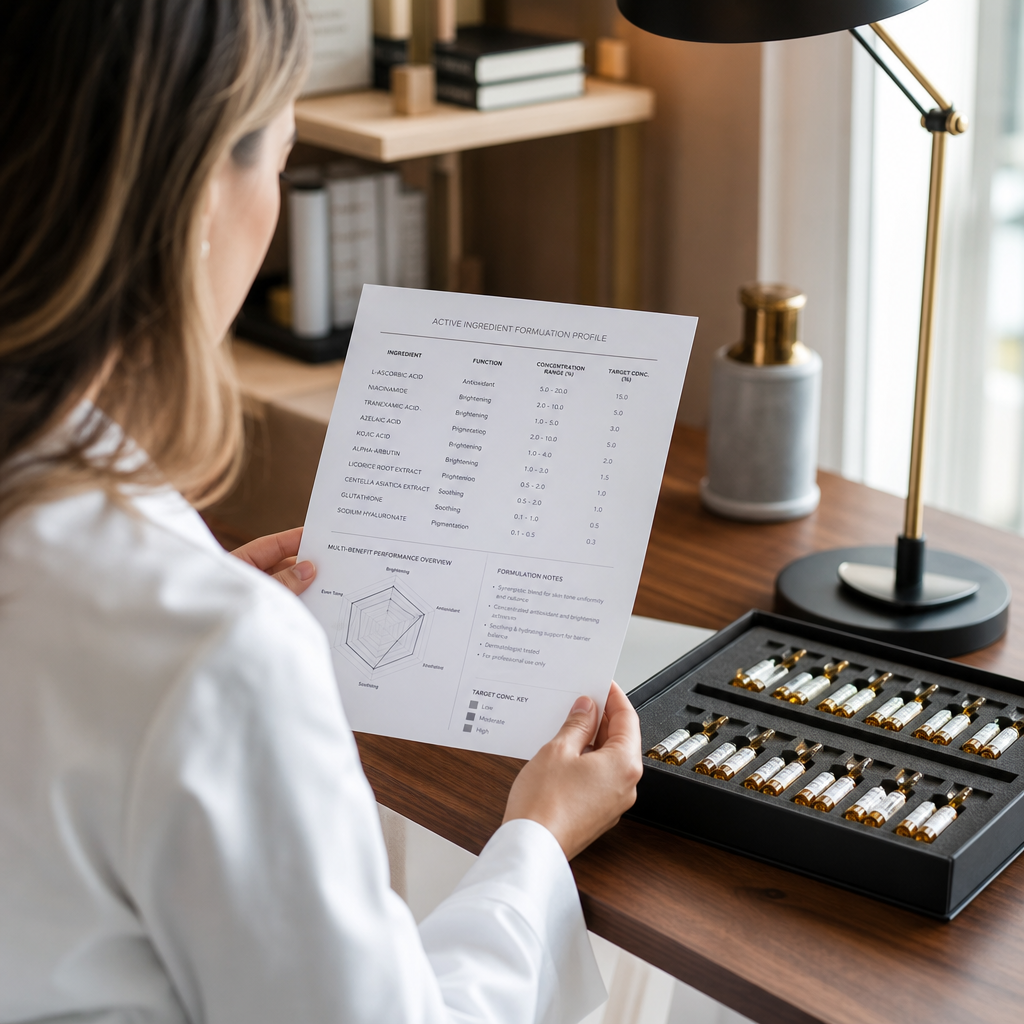
Professionals do not choose ingredients in isolation. They look at compatibility, barrier status, and how the skin is likely to respond over time. That means reducing inflammation when needed, avoiding clashes between low-pH acids and delicate peptides, and pairing antioxidants with hydrators when the barrier is under stress.
With more active ingredients entering the market, random layering can create more irritation than progress. Christina Cosmeceuticals approaches this by matching high-potency formulas to the skin problem rather than pushing the same routine across every client.
Barrier-compromised and sensitized skin
When the barrier is damaged, the first priority is support. Formulas built around ceramides, centella asiatica, and lower-dose niacinamide are often better choices than acids or retinoids. If the skin is actively reactive, exfoliation usually needs to pause.
Oily and congestion-prone skin
Congestion is best managed by controlling oil without stripping the skin. Salicylic acid, zinc PCA, kaolin, and lightweight antioxidant support can work well here. Very heavy creams may be too much for this skin type, especially if breakouts are active.
Mature, photodamaged skin
For mature skin, the goal is usually renewal without unnecessary irritation. A common professional approach looks like this:
- Use vitamin C in the morning for antioxidant support.
- Use retinoids at night for renewal.
- Avoid combining vitamin C and copper peptides in the same routine if the formula is not designed for it.
- Do not layer strong AHAs and retinoids at the same time unless the protocol is specifically built that way.
| Feature | Barrier-Compromised | Oily & Congested | Mature & Photodamaged |
|---|---|---|---|
| Recommended Actives | Ceramides, Centella Asiatica | BHAs, Zinc PCA, Kaolin | Retinoids, Peptides, Antioxidants |
| Actives to Avoid | AHAs, Retinoids, L-Ascorbic Acid | Heavy occlusive creams | Benzoyl Peroxide with Retinoids |
| Cycling Notes | Pause exfoliation until the barrier settles | Alternate clarifying care with hydration | Separate AM and PM actives |
Why Delivery Systems Matter More Than the Ingredient Label
Even the right ingredient can fall short if it never reaches the area where it is supposed to act. Delivery systems matter because they influence penetration, irritation, and overall performance. A strong ingredient list does not guarantee results if the formula is not built well.
Encapsulation, liposomal carriers, and biomimetic technology
Encapsulation and liposomal carriers can help release actives more gradually and reduce the chance of surface irritation. Biomimetic systems aim to work in a way that is more compatible with the skin’s own lipid structure. For professional skincare ingredients, that can make a meaningful difference, especially with retinoids and other actives that are more likely to irritate when left unbuffered.
How professional formulations achieve cellular-level delivery
Professionals usually look beyond the INCI list and ask how the formula is engineered. A retinol product, for example, may be better tolerated when it is encapsulated or time-released, because the ingredient is introduced more gradually. That is often the difference between a product a client can use consistently and one that gets abandoned after a few applications.
| Formulation Aspect | Standard OTC | Professional Formulations |
|---|---|---|
| Delivery Method | Surface-level | Encapsulation or biomimetic delivery |
| Ingredient Action | Mainly surface support | More targeted release and use |
For licensed professionals, delivery is not a bonus feature. It is part of whether the product is usable in the real world.
Building a Treatment Protocol: How Professionals Select and Layer Cosmeceutical Ingredients
Professionals build protocols by looking at the skin state, deciding what the skin can tolerate, and then pairing in-clinic treatments with a home-care plan that keeps progress moving. This is especially useful when the client has more than one concern, such as acne plus pigmentation or aging plus sensitivity.
The dual-system approach: in-clinic treatments paired with home-care regimens
A single product rarely solves everything. Christina Cosmeceuticals uses a dual-system approach that connects clinical procedures, such as Rose De Mer peeling technology, with daily-use formulas that support the same goal at home. That kind of structure matters because it gives the skin a clearer path from treatment to maintenance.
Step-by-step protocol design for complex skin concerns
When working with potent cosmeceutical ingredients, a simple, staged plan is usually safer and more effective than trying to do everything at once:
- Assess and Prep: Identify the main skin issue, then stabilize the barrier if needed.
- In-Clinic Intervention: Use higher-strength treatments to address the primary concern.
- Home-Care Prescription: Build a routine that supports progress without creating chronic irritation.
- Cycling and Maintenance: Move between corrective phases and recovery phases as the skin adapts.
That kind of pacing is what makes professional skincare work in practice. The product matters, but so does the sequence.
What to Look for When Evaluating a Cosmeceutical Brand's Ingredient Standards
When evaluating a brand, professionals should look past the marketing claims and ask the practical questions. Are the actives clearly identified? Are concentrations or delivery methods explained? Is the line built for specific skin states? Is there real support for professional use?
As the market continues to expand, the best brands are the ones that make formulation choices easy to understand. A global footprint, professional-only catalog, and concern-based ranges can all be useful signals, but they should be backed by clarity and consistency.
- Verify global footprint: A presence in 70+ countries can signal that a brand is built to work across different professional markets and regulatory environments.
- Assess catalog exclusivity: Professional-only lines and training support help ensure products are used correctly.
- Evaluate targeted ranges: Look for concern-led collections rather than generic single-ingredient products.
- Demand transparency: The best formulas explain how active ingredients in cosmeceuticals are meant to work and where they fit in a protocol.
For professionals and serious consumers alike, the goal is the same, find cosmeceutical ingredients that are matched to the skin, not just promoted to it.
FAQ: Cosmeceutical Ingredients
FAQ: Cosmeceutical Ingredients in brief: Cosmeceutical ingredients are generally regulated by the FDA as cosmetics unless drug claims are made. The most effective actives for aging skin usually include retinoids, peptides, and antioxidants. Compared with standard cosmetic products, professional formulas are defined by concentration, delivery technology, and better ingredient pairing. A licensed skin assessment helps match the right actives to the right skin state.
Navigating professional skincare ingredients means understanding both the science and the limits of a formula. These answers cover the questions people ask most often when comparing cosmeceuticals with standard cosmetics.
Are active cosmeceutical ingredients regulated by the FDA?
Yes, in the U.S. they are generally regulated as cosmetics unless the product makes drug claims, such as treating acne as a disease or changing the structure of the skin. If a formula crosses into those claims, it may be treated differently under FDA rules.
What are the most effective actives for aging skin?
For aging skin, retinoids are usually the anchor ingredient, especially when the goal is to improve the look of fine lines, texture, and firmness. Peptides and antioxidants are often added to support the routine and help the skin tolerate long-term use.
Can I use pro-grade products at home without professional guidance?
Some professional lines are designed for home care, but it still helps to have a skin assessment first. Stronger actives are easier to use well when they are matched to the right skin state from the start.
What makes professional formulations different from drugstore actives?
The main differences are concentration, delivery, and formula design. Drugstore products often focus on basic surface care, while professional formulations are more likely to combine multiple actives in a way that supports specific skin concerns and longer-term results.
Sources
- Cosmetic Ingredients Market Size Worth USD 61.94 Billion by - globenewswire.com (2034)
- Skincare Ingredients Market Size & Share Report, 2025 – 2034 - gminsights.com (2034)
- Skin Care Ingredients Market Share and Statistics 2025-2035 - factmr.com (2035)
- Cosmetics Active Ingredients Business Report 2025: Global Market to Reach $6.3 Billion by 2030 from $4.5 Billion in 2024 - Conditioning Agents Leads, Anti-Aging Active Ingredients to Boost Growth - globenewswire.com (2030)
- Cosmetic Ingredients Market Size, Growth, Trends ... - technavio.com (2029)
Frequently Asked Questions
How long does it take to see visible skin improvements when using professional cosmeceutical ingredients?
While surface hydration can improve within a few weeks, structural changes like collagen remodeling and pigment reduction typically require 8 to 12 weeks of consistent application. Christina Cosmeceuticals optimizes this timeline by pairing concentrated in-clinic treatments with complementary home-care regimens to accelerate cellular turnover safely. Consulting a licensed skincare professional ensures your routine is paced correctly for your specific skin state.
Why do advanced delivery systems matter more than active ingredient percentages?
High percentages of active ingredients can cause severe barrier irritation if they sit entirely on the skin surface without penetrating effectively. Advanced delivery technologies, such as the biomimetic complexes and encapsulation used by Christina Cosmeceuticals, transport actives deeper into target layers while minimizing irritation. This controlled release allows potent cosmeceutical ingredients to perform their intended corrective work without compromising skin health.
How should I transition from standard OTC products to a high-potency cosmeceutical regimen?
Begin by stabilizing the skin barrier with soothing hydrators before introducing concentrated actives one at a time, cycling them between morning and evening routines. Consulting a licensed skincare professional helps identify whether your skin requires barrier repair, clarifying care, or pigment correction first. Exploring targeted cosmeceutical lines tailored to your exact skin profile ensures a smooth transition without triggering rebound inflammation.