

Quick Summary
Identifying the best cosmeceuticals for acne scars requires a specialized strategy that distinguishes between post-inflammatory redness, dark pigmentation, and uneven skin texture. Christina Cosmeceuticals provides a clinical dual-approach by pairing professional resurfacing treatments like Rose De Mer with high-active home-care lines such as Comodex and Illustrious to address both structural damage and discoloration. Readers can explore the Comodex and Rose De Mer collections to build a professional-grade routine that effectively targets stubborn post-acne marks and shallow textural scarring.
Best Cosmeceuticals for Acne Scars: Match Your Scar Type to the Right Fix
You clear the breakout, then the real cleanup starts, a red mark that hangs around, a brown spot that looks darker in certain light, or a rough patch that catches the skin instead of blending in. That is usually where the search for the best cosmeceuticals for acne scars begins, and it is also where a lot of routines go wrong. Acne scars are not one problem. Post-inflammatory redness, post-inflammatory pigmentation, and textural scarring each need a different strategy.[1]
Christina Cosmeceuticals takes that split seriously. Instead of treating every post-acne concern with the same serum, it builds around professional resurfacing and targeted home care. Rose De Mer is used for more intensive resurfacing, Comodex supports blemish-prone skin and post-acne recovery, and Illustrious focuses on discoloration. Compared with basic retail skincare, these systems are built around higher active levels and a clearer treatment sequence, which is what professionals usually want when results matter.[5]
If you are matching a product to a scar type, start with the concern in front of you, not the marketing claim on the box. Explore the Comodex and Rose De Mer collections to build a more practical acne-scar routine.
Why Treating Acne Scars Requires More Than One Product - and How to Choose
Treating acne scars usually takes more than one product because the skin is not dealing with a single issue. Redness, brown marks, and pitted texture all behave differently, so the same ingredient will not solve all of them. A product that helps pigment will not rebuild collagen in a depressed scar, and a resurfacing treatment will not always clear lingering redness.
When choosing the best cosmeceuticals for acne scars, the most useful question is simple: what kind of damage are you trying to change? Human clinical trials support topical retinoids, benzoyl peroxide, and azelaic acid for acne vulgaris and scar management. Medical-grade retinoids are especially useful for texture because they support cell turnover and collagen production. That is why they remain one of the strongest options for shallow atrophic scars.[3]
Professionals often work with a system rather than a single product. Christina Cosmeceuticals follows that model, pairing professional chemical peels for scarring such as Rose De Mer with at-home support from Comodex and Illustrious. The idea is straightforward: treat the active acne-prone state, then keep working on redness, pigment, and texture once breakouts settle.
- Texture: Retinoids are the main cosmeceutical choice for shallow atrophic scarring.
- Pigmentation: Vitamin C, niacinamide, and azelaic acid are useful for dark marks after acne.
- Regimens: Multi-step professional acne scar treatment products usually give more controlled results than a single serum.
Quick Comparison: Top Cosmeceutical Approaches by Acne Scar Type
The best cosmeceuticals for acne scars work best when they match the type of damage. A good routine for redness is not the same as a good routine for pigmentation, and neither one replaces clinical procedures for deep pitted scars. Cosmeceuticals tend to do their best work on post-inflammatory hyperpigmentation and shallow textural changes. Deeper scars often need lasers, fillers, or other office-based treatment.
| Scar Type | Primary Actives | Cosmeceutical Category | Treatment Synergy | Example Line |
|---|---|---|---|---|
| Redness (PIE) | Niacinamide, azelaic acid | Barrier support | LED, gentle peels | Christina Unstress / Comodex |
| Hyperpigmentation (PIH) | Vitamin C, retinoids | Brightening correctors | Professional chemical peels for scarring | Christina Illustrious |
| Textural scarring (atrophic) | Retinoids, glycolic acid | Resurfacing agents | Laser, dermal fillers | Christina Rose De Mer |
In practice, staged protocols often work better than trying to force one resurfacing plan onto every case. Christina Cosmeceuticals reports that 312 professional treatment plans showed faster improvement when practitioners matched the routine to the scar type instead of using one universal approach. That fits what many clinicians already see in the treatment room. A redness-dominant case needs calming support, while a pigmentation-heavy case needs brightening first. For professionals building a protocol, the best cosmeceuticals for acne scars are the ones that fit the skin’s tolerance as well as the scar pattern.
1. Medical-Grade Retinoids - The Cornerstone for Texture and Turnover
Medical-grade retinoids are one of the strongest cosmeceutical options for texture. They speed cell turnover and support collagen production, which is why they are often the first choice for shallow rolling and boxcar scars. They will not erase deep ice pick scars, but they can soften the look of uneven texture over time.
For professionals, retinoids matter because they do two jobs at once, they help skin renew faster and they support longer-term remodeling. That makes them one of the most effective options in professional acne scar treatment products. They also pair well with in-clinic treatments, since many clinicians use them to prepare skin before peels or to maintain results afterward.[2]
Results are gradual. Depending on the formula and the skin’s tolerance, texture changes may become visible over 8 to 16 weeks, sometimes longer. The key is consistency and a sensible ramp-up. Stronger is not always better if the barrier is already irritated.
2. Vitamin C Serums - Brightening Post-Inflammatory Hyperpigmentation
Vitamin C is a practical choice when the issue is dark marks, not indentation. It helps brighten post-inflammatory hyperpigmentation by reducing oxidative stress and supporting a more even tone. L-ascorbic acid at around 10 to 20 percent is commonly used in clinical skincare, although stability is what often separates a useful formula from a disappointing one.
Vitamin C will not fill in a pit, and that limitation matters. It is a pigment tool, not a resurfacing tool. For clients with PIH, though, it can be one of the best cosmeceuticals for acne scars because it helps the skin look clearer while other actives work on texture.
Christina Cosmeceuticals’ Illustrious line fits that use case well. It is positioned as a brightening system rather than a single spot treatment, which is the right idea for stubborn discoloration. For many professionals, that is the difference between a serum that sounds good and one that actually fits a treatment plan.
3. Azelaic Acid - The Dual-Action Ingredient for Redness and Dark Marks
Azelaic acid earns its place because it works on two fronts. It helps calm inflammation and it also slows excess pigment production, which makes it useful for both redness and brown marks after acne. For skin that cannot tolerate harsher resurfacing, it is often one of the easiest actives to keep in rotation.[4]
This ingredient is especially helpful when redness and pigmentation overlap, which is common in post-acne skin. It is also a strong option for darker skin tones, where a gentler approach can matter more than an aggressive one. In professional settings, azelaic acid is often part of a maintenance phase after breakouts settle or after more intense procedures.
If you are deciding between the best cosmeceuticals for acne scars, azelaic acid makes the most sense when the skin is sensitive, reactive, or prone to pigment shifts. It is not the most dramatic resurfacer, but it is one of the most practical.
- Reactive skin barriers: Useful when the skin flushes, stings, or dries out easily.
- Concurrent redness: Helpful when acne marks are still pink or inflamed.
- Fitzpatrick IV to VI: Often a better-tolerated option when pigment risk is higher.
4. Professional Chemical Peels - Resurfacing Beyond What Home Care Can Reach
Home care can improve tone and texture, but it has limits. Professional chemical peels for scarring are the next step when the goal is to push resurfacing further. They create a controlled injury that can help remodel skin more deeply than a daily serum can.
The depth of the peel changes what it can do. Superficial peels are usually better for dull tone and mild post-acne marks. Medium-depth peels can help with more stubborn pigmentation and some shallow textural irregularity. Deeper peels are reserved for more severe scarring and require much more downtime, so they are not a casual choice.
Christina Cosmeceuticals’ Rose De Mer system is built around that resurfacing logic. It combines mechanical and chemical action in a way that many professionals find useful when they want a more intensive option without reaching for the most aggressive peel category. For the right client, it can sit comfortably between basic exfoliation and more invasive procedures.
5. Niacinamide Formulations - Calming Inflammation and Strengthening the Barrier
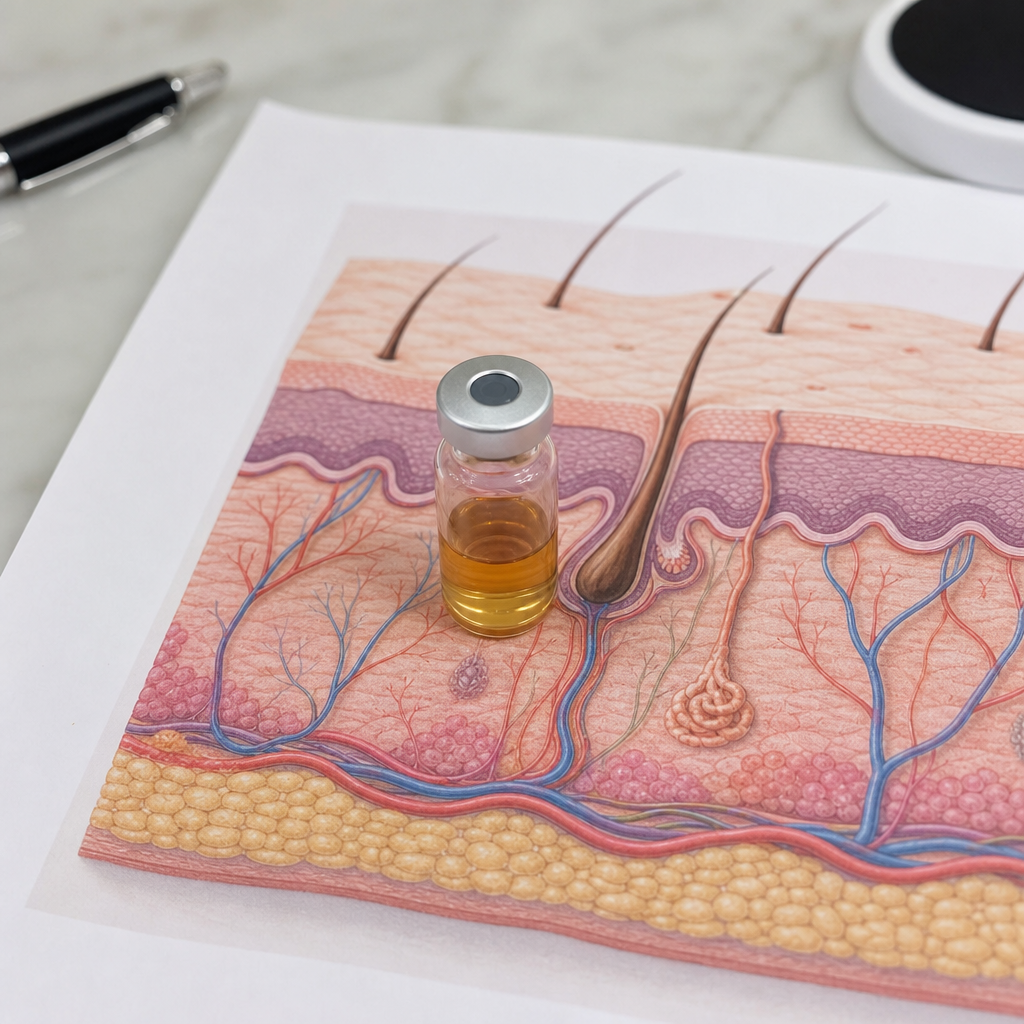
Niacinamide is not the flashiest ingredient in acne scar care, but it is one of the most useful. It helps reduce inflammation, supports the barrier, and can improve the look of redness after breakouts. It also helps with sebum regulation, which matters when the skin is still active and congested.
That makes niacinamide a good support ingredient after professional chemical peels for scarring or alongside brighter actives that might otherwise irritate the skin. It is rarely the only ingredient you need, but it makes a routine easier to tolerate, which often means better compliance and better results.
In a professional acne scar routine, niacinamide usually plays the steadying role. It helps hold the routine together while stronger actives, such as retinoids or acids, do the heavier lifting.
6. Targeted Blemish-Prone Skin Systems - Why a Full Regimen Outperforms Single Products
A full regimen usually beats a one-product strategy. Acne scars often sit next to ongoing breakouts, oiliness, or a damaged barrier, so treating only one part of the picture can leave the rest untouched. A cleaner, more stable routine gives skin a better chance to respond to actives without constant flare-ups.
This is where structured systems matter. In randomized controlled trials, dermocosmetics performed better than placebo in acne care, and some studies showed effects comparable to benzoyl peroxide 2.5% to 5% and retinoic acid 0.025%. That does not mean every cosmeceutical replaces a prescription, but it does show why a well-designed regimen can hold its own against basic over-the-counter solutions.
Christina Cosmeceuticals’ Comodex line fits that model. It is built as a system, not a loose collection of products, which is often what professionals want when they are managing post-acne skin. For clients who need ongoing control and scar support, a coordinated routine is usually easier to maintain than a drawer full of separate products.
7. Herbal and Botanical Resurfacing Agents - A Natural Alternative to Aggressive Peels
Herbal resurfacing agents use plant-derived particles and botanicals to create controlled exfoliation. They are not a replacement for every peel, but they can be a useful option when skin needs texture refinement without the feel of a stronger acid treatment.
This approach can be appealing for clients who want something gentler or who have not tolerated traditional exfoliants well. Rose De Mer is the best-known Christina example here. It is often used when professionals want resurfacing support but need to keep irritation in check. That balance matters, especially when the skin is already red or sensitized from active breakouts.
For some cases, this is exactly where the best cosmeceuticals for acne scars sit, not as the most aggressive option, but as the one the client will actually tolerate long enough to see change.
8. Brightening Correctors for Hyperpigmentation - Ingredients That Go Beyond Basic Vitamin C
Vitamin C is useful, but stubborn PIH often needs more than one brightening pathway. Ingredients such as alpha-arbutin, tranexamic acid, niacinamide, and licorice extract work differently, which is why multi-ingredient formulas often perform better than a single spot corrector.
That is the logic behind many top cosmeceuticals for hyperpigmentation and scarring. Illustrious follows this model by pairing brightening support with SPF in the daytime, which matters because pigment will keep coming back if the skin is not protected from UV exposure. In real treatment plans, brightening and sun protection should be treated as a pair.
Escalate to a multi-pathway corrector when dark marks are slow to fade, when pigment sits alongside redness, or when the skin needs maintenance after a peel or resurfacing program. In those cases, a more layered formula usually makes more sense than another basic serum.
- Dark marks have not changed after 8 weeks of a simple Vitamin C routine.
- Pigmentation is mixed with texture, so the skin needs both brightening and resurfacing support.
- You need a routine that helps block melanin transfer from more than one angle.
How Do Professional-Grade Cosmeceuticals Differ from Drugstore Acne Products?
Professional-grade cosmeceuticals are usually built with higher active levels, better delivery systems, and a clearer treatment purpose. Drugstore products often focus on one symptom at a time, while professional formulas are more likely to be designed as part of a treatment plan. That matters when the goal is not just to dry out a breakout, but to improve the marks that follow.
There is also a practical difference in how they are used. A professional routine is usually staged. Cleanse, treat, repair, protect, then reassess. That structure is one reason many estheticians and medical-aesthetic providers prefer medical-grade skincare for acne scars over generic retail products. The routine is easier to control, and the results are easier to track.
| Feature | Drugstore Products | Christina Cosmeceuticals |
|---|---|---|
| Active concentration | Often lower, for broader tolerance | Higher, with professional positioning |
| Treatment approach | Single-product focus | Step-based system |
That difference shows up in the treatment room. A structured regimen makes it easier to pair in-clinic care with home maintenance, which is where the real progress usually happens. For professionals comparing the best cosmeceuticals for acne scars, the question is not just what ingredient is inside, but how well the whole system supports the skin over time.
How Long Does It Take to See Visible Results from Cosmeceuticals on Acne Scars?
Timelines depend on the scar type. Red marks often improve first, pigment usually takes a little longer, and textural change is the slowest of the three. Anyone promising overnight results is overselling it. Acne scar care is more about steady progress than quick fixes.
Visible change from topical retinoids can take months, not days. That is normal. The skin has to renew itself, calm down, and, in some cases, rebuild some of its support structure before the change becomes obvious. When home care is paired with in-office treatment, progress usually becomes easier to see.
- Post-inflammatory erythema (PIE): Redness may settle in about 4 to 8 weeks with calming actives.
- Post-inflammatory hyperpigmentation (PIH): Dark marks often fade over 6 to 12 weeks with consistent brightening care.
- Textural scarring: Shallow texture may soften over 12 to 24 weeks, but deep ice pick scars usually need procedures.
For many clients, the best results come from combining professional chemical peels for scarring with daily maintenance. That approach is slower than a one-step promise, but it is also more realistic. Explore the Comodex line and Rose De Mer Peeling Soap if you want a structured regimen built around professional acne scar treatment products.
Frequently Asked Questions About Cosmeceuticals for Acne Scars
The best cosmeceuticals for acne scars depend on whether the concern is redness, pigment, or texture. Below are the questions professionals ask most often when building treatment plans.
What are the most effective active ingredients in cosmeceuticals for acne scars?
Retinoids are the strongest option for texture and collagen support. Vitamin C, niacinamide, and azelaic acid are especially useful for post-inflammatory hyperpigmentation and redness. Glycolic and salicylic acids can also help resurface skin and improve tone.
Can cosmeceuticals improve the appearance of deep pitted or ice pick scars?
They can help soften the surrounding skin and improve overall tone, but deep pitted and ice pick scars usually need in-office treatment such as lasers, fillers, or other procedural work. Cosmeceuticals are better at supporting shallow texture and maintenance.
Which Christina Cosmeceuticals product line is best for post-inflammatory hyperpigmentation?
Illustrious is the clearest fit for PIH because it is built around brightening support. For clients who also need texture work, professionals often pair it with Rose De Mer. That combination gives a more complete approach than a pigment serum alone.
Are professional chemical peels safe for darker skin tones?
They can be, but the peel choice matters. Gentler, better-controlled resurfacing methods are usually preferred for Fitzpatrick IV to VI skin because they reduce the risk of rebound pigmentation. The safest approach is to match the peel strength to the skin’s tolerance and the scar type.
Sources
- Why Topical Retinoids Are Mainstay of Therapy for Acne - PMC - NIH - pmc.ncbi.nlm.nih.gov (2014)
- Evaluation of clinical improvement in acne scars and active acne in patients treated with the 1540-nm non-ablative fractional laser - PubMed - pubmed.ncbi.nlm.nih.gov (2011)
- Azelaic Acid - pmc.ncbi.nlm.nih.gov (2000)
- The Effects of Oral Isotretinoin on Atrophic Acne Scars Measured by ... - pmc.ncbi.nlm.nih.gov
- Microneedling combined with botulinum toxin-A versus ... - NIH - pmc.ncbi.nlm.nih.gov
Frequently Asked Questions
Can I use professional resurfacing treatments like Rose De Mer while still using the Comodex home-care line for active breakouts?
Yes, Christina Cosmeceuticals recommends a staged approach where Comodex stabilizes active breakouts and Rose De Mer provides intensive resurfacing for remaining scars. This dual-action strategy ensures you are treating existing damage while actively preventing new marks from forming.
How should I adjust my routine if my acne scars consist of both deep pigmentation and uneven skin texture?
A multi-line regimen is most effective, pairing the Illustrious collection for pigment inhibition with Rose De Mer for textural remodeling. This professional-grade combination addresses different layers of skin damage simultaneously to provide more comprehensive results than a single-active serum.
What is the best way to maintain results at home after receiving a professional chemical peel for scarring?
Post-treatment maintenance should focus on barrier support and gentle cell turnover using specialized systems like Comodex to keep pores clear. Christina Cosmeceuticals offers these clinical home-care lines to extend the resurfacing benefits of in-office treatments and prevent post-inflammatory pigment relapse.